Interested in joining the Gordon Children's Academy in September 2027?

Join us for our Open Morning Tours to see our school in action and meet our staff and children. 
Spaces are limited so please secure your place by booking here.


To help keep all pupils safe, please ensure the school has up-to-date information about any allergies your child may have. Accurate allergy information enables us to put appropriate support plans in place, train staff effectively, and respond quickly in an emergency. We all have a part to play in creating a safe environment, including following our nut-aware policy and being mindful of the food brought into school. If your child has an allergy, please contact the school or update their details via Arbor. Be Allergy Aware and Save A Life - see more here.

Curriculum Intent

At Gordon Children’s Academy, we believe that mathematics is a creative, interconnected and essential discipline that enables children to make sense of the world around them. Mathematics provides the foundation for understanding science, technology, engineering and everyday life, while developing the skills needed for future education, employment and financial literacy. We aim to foster a love of mathematics by encouraging curiosity, resilience, confidence and a willingness to take risks in learning.

Our mathematics curriculum is designed in line with the National Curriculum and is underpinned by the belief that all children can achieve success in mathematics through high expectations, effective teaching and appropriate support. We provide a rich and engaging learning environment where pupils are encouraged to think mathematically, explore ideas, make connections and develop a deep conceptual understanding.

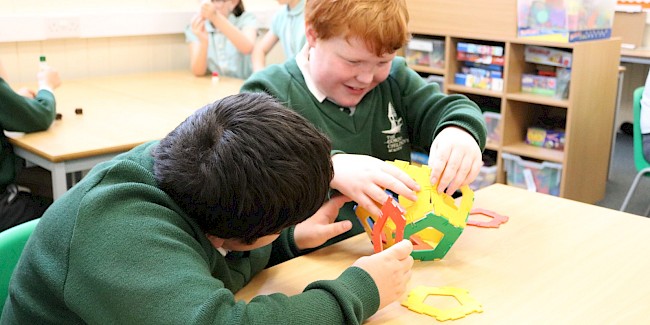
Children are taught to move fluently between different representations of mathematical concepts using the Concrete, Pictorial and Abstract (CPA) approach. This enables pupils to develop secure mathematical understanding, make meaningful connections between ideas and apply their knowledge with confidence. Lessons are carefully sequenced to build upon prior learning, ensuring that key concepts are revisited and developed over time. Through this approach, children develop fluency, reasoning and problem-solving skills while recognising the relationships between different areas of mathematics.

We believe that mistakes are an essential part of learning and encourage children to view challenges positively, developing perseverance, resilience and independence as mathematicians. Through discussion, exploration and collaborative learning, pupils are supported to explain their thinking, justify their reasoning and build confidence in communicating mathematically.

At Gordon Children’s Academy, we aim to:

  • Provide a supportive, inclusive and stimulating learning environment where every child can achieve their full potential in mathematics.
  • Develop confident, resilient learners who are willing to take risks, learn from mistakes and persevere when solving problems.
  • Promote enjoyment and enthusiasm for mathematics through practical experiences, investigation, discussion and real-life application.
  • Foster a deep conceptual understanding through the consistent use of the Concrete, Pictorial and Abstract (CPA) approach.
  • Develop fluency in mathematical facts, procedures and methods, enabling children to recall and apply knowledge accurately and efficiently.
  • Encourage pupils to reason mathematically by explaining their thinking, making conjectures, identifying patterns and justifying their conclusions using mathematical language.
  • Enable children to solve a variety of routine and non-routine problems, applying their knowledge and skills in increasingly sophisticated contexts.
  • Support children in making rich connections across mathematical concepts and across the wider curriculum.
  • Develop positive attitudes towards mathematics, building confidence and a growth mindset in all learners.
  • Prepare pupils with the mathematical knowledge, understanding and skills they need for the next stage of their education and later life.

Our Vision

We strive to develop confident, competent and enthusiastic mathematicians who leave Gordon Children’s Academy with the knowledge, skills and resilience needed to succeed in the next stage of their education and throughout their lives. Through high-quality teaching, ambitious expectations and a mastery approach to learning, we ensure that every child experiences success and recognises the value and power of mathematics in the world around them.

Curriculum Journey

Early Years Foundation Stage (EYFS)

Mathematics in the Early Years focuses on developing a strong grounding in number and numerical patterns, providing children with the building blocks needed for future mathematical success.

Children are encouraged to:

  • Count confidently and accurately.
  • Develop a secure understanding of numbers to 10, including their relationships and composition.
  • Explore patterns and make connections between numbers.
  • Use practical resources and manipulatives to support understanding.
  • Develop spatial reasoning skills through shape, space and measure activities.
  • Talk about their mathematical thinking and explain what they notice.
  • Develop positive attitudes towards mathematics, demonstrating curiosity, confidence and willingness to have a go.

Through rich, practical experiences, children build the knowledge, vocabulary and understanding that form the foundation of mathematical mastery.

Key Stage 1

The principal focus in Key Stage 1 is to develop confidence and fluency with whole numbers, counting and place value.

Pupils will:

  • Develop secure understanding of number and the four operations.
  • Use practical resources, representations and mathematical equipment to support learning.
  • Recognise, describe, compare, sort and draw a variety of shapes.
  • Develop understanding of measures including length, mass, capacity, time and money.
  • Learn and apply number bonds to 20.
  • Develop accuracy and fluency within place value.
  • Use mathematical vocabulary correctly in speaking, reading and writing.
  • Begin to explain their reasoning and solve problems in a range of contexts.

Lower Key Stage 2 (Years 3 and 4)

The principal focus in Lower Key Stage 2 is to develop greater fluency with whole numbers and the four operations, alongside strengthening reasoning and problem-solving skills.

Pupils will:

  • Become increasingly fluent in mental and written calculation methods.
  • Develop a secure understanding of place value in larger whole numbers.
  • Solve problems involving fractions and decimal place value.
  • Draw and interpret mathematical representations with increasing accuracy.
  • Analyse shapes and their properties while describing relationships between them.
  • Use measuring instruments accurately and make connections between measure and number.
  • Explain and justify mathematical thinking using precise vocabulary.
  • Memorise and confidently recall multiplication facts up to 12 × 12 by the end of Year 4.

Upper Key Stage 2 (Years 5 and 6)

The principal focus in Upper Key Stage 2 is to extend understanding of the number system and build connections between different mathematical concepts.

Pupils will:

  • Develop fluency with larger integers and increasingly complex calculations.
  • Make connections between fractions, decimals, percentages, ratio and proportion.
  • Solve increasingly sophisticated mathematical problems using efficient methods.
  • Develop understanding of algebraic thinking and use mathematical language to generalise patterns and relationships.
  • Consolidate and extend knowledge of geometry and measures.
  • Classify and describe shapes with increasingly complex geometric properties.
  • Select and apply the most efficient strategies to solve problems.
  • Communicate mathematical thinking clearly using accurate mathematical vocabulary.

By the end of Year 6, pupils should be fluent in written methods for all four operations, including long multiplication and long division, and demonstrate confidence when working with fractions, decimals and percentages. They should be able to reason mathematically, solve complex problems and communicate their understanding clearly and accurately.